Getting Frank: Producer Panel Discusses Jersey Ancestry Recording Program, Future, Technology
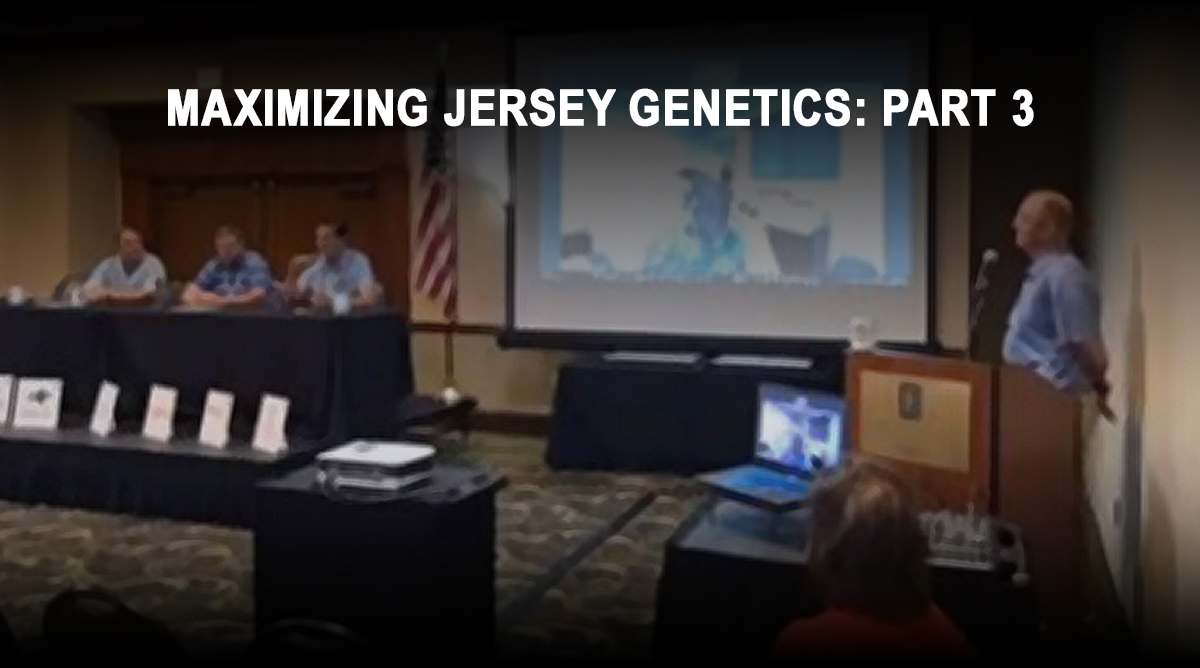
In the final round of a three-part series on the panel discussion “Maximizing Jersey Genetics,” four Jersey breeders talk about ancestry recording programs, breed progress and technology. The four spoke at a session held in conjunction with the annual meeting of the American Jersey Cattle Association (AJCA) at the Embassy Suites-UK Coldstream in Lexington, Ky., on June 26.
The panelists included Joel Albright, Albright Jerseys LLC, Willard, Ohio; Alan Chittenden, Dutch Hollow Farms LLC, Schodack Landing, N.Y.; Cornell Kasbergen, Kash-In Jerseys, Tulare, Calif.; and Brent Wickstrom, Wickstrom Jersey Farm, Hilmar, Calif. The panel was moderated by Brad Barham, Anderson, S.C., with Red-Land Ag LLC, a dairy consulting company that specializes in IVF and embryo transfer programs.
Chittenden is currently serving his fourth term as president of the AJCA. Albright is a former AJCA director and is now serving as a director for National All-Jersey Inc. Kasbergen is in his second term as an AJCA director and is also vice president of the organization.
The first part of this series was published in the October 2025 issue of the Jersey Journal. The second part was carried in the November issue.
A primer on the breed’s ancestry recording programs may prove useful in grasping the panelists’ responses to questions about Jersey genetics. The first program to provide a pathway to registration of grade Jerseys was Genetic Recovery, adopted in 1975. Seasoned Jersey breeders may recall this program allowed animals with known Jersey characteristics (purebreds) to be recorded by the AJCA using the prefix OA for the original animal and the prefixes PR (provisional register), then GR (genetic recovery) for subsequent generations. The fourth generation was given Herd Register (HR) status and required no prefix.
Jersey Expansion was implemented in 1999 as the first “crossbred” program, designed to capitalize on the growing use of Jersey semen on other-breed females. Animals with both Jersey and other-breed genetics could be recorded by the AJCA using J1 for the first generation and J2-J6 for subsequent generations. Seventh-generation animals earned HR status.
In May 2016, the Generation Count (GC) system replaced Genetic Recovery and Jersey Expansion. A GC suffix was added to an animal’s registration name when its pedigree included at least one unknown animal or an animal of another breed. GC counts of 1-6 were used in brackets as a suffix and JX as a prefix. The name of the first unknown or other-breed animal in the pedigree included a suffix of {1}. The numerical designation for progeny increased by one with each subsequent generation. After six generations, the GC and JX were dropped, and the animal was deemed to have Herd Register status. Animals with GC status were commonly called “JX” and “bracket” animals. For example, an animal with a {5} suffix was often called a “five.”
At that point, another tool, Breed Base Representation (BBR), was adopted to complement GC. BBR values, calculated by the Council on Dairy Cattle Breeding, assess the relationship of a genotyped animal to the purebred reference group for Jersey and all other breeds with genomic evaluations (Ayrshire, Brown Swiss, Guernsey and Holstein). The more an animal’s genetic make-up resembles the purebred reference group, the higher the BBR.
Most recently, the AJCA board adopted Percent Jersey Ancestry (PJA) as a replacement for the GC system. PJA is a pedigree-based estimate of breed composition, calculated by averaging the PJA of an animal’s parents, tracing back to the earliest ancestors. To move the breed back to purebred status, the board approved an incremental increase in GC and PJA for all bulls registered by the AJCA. Registration names of all animals will continue to carry the GC suffix and the JX prefix. As well, both PJA and BBR are included on official performance pedigrees and performance progeny reports.
Barham: We have discussed sire selection, breed programs, beef on dairy, and IVF. Now let’s talk a little about JX, BBR and PJA. How have these systems impacted the breed, and what are you doing at home?
Chittenden: There are probably some semen guys out there who could give us more accurate numbers (on JX and PJA), but in our herd, we still have some that are pure Jerseys, with no JX ever. I don’t think that is that important, though. I am fine with having the sixes and some cattle that have some of that in their background. I never went too deep on it, so I don’t think it influences our program a lot. It is just my guess, but I think the breeders who are really focused on it are probably buying a pretty small percentage of the semen out there. Regarding pure animals, there are some good ones, but number-wise, they don’t rank high enough for me to chase their genetics in an IVF program. I won’t use them unless I see some money coming somewhere from somebody who wants to pay for them.
Albright: As a breed association, we have started down a path of getting to a higher percentage of Jersey ancestry. Percent Jersey Ancestry will give us more transparency. Regardless of your opinion on this issue, I think one of the big roles of the association is to be as transparent as possible. The recent decisions made at some board meetings will definitely help with that. You can make your own decisions on your own farms and be confident about it.
As far as at home, as Alan said, fives and sixes are probably pretty prevalent in our pedigrees at this point. I did a search recently and found we had just 50-60 head that were JX-free. There is an opportunity in HerdView to click on a button that will help you identify JX-free animals. You can do the same thing with BullsEye. So, if you want to make sure you preserve those pedigrees, you can do it. Ultimately, what will get made is what we buy as an industry. If you guys are complaining about what is being made available, remember you vote with your dollars every day with what you buy for semen.
Kasbergen: When the JX thing came out, we initially tried to resist, and I think we are going to look back on that period of Jersey history as a lost decade. I call it that. I think we have really hurt genetic progress. When you have proven bulls that are just as high as genomic bulls, that indicates we lost something somewhere. Something happened because you don’t see it in some of the other breeds. I think we are finally getting out of that.
We use a lot of fives and sixes. We got to that point: if you are going to be in the game, you almost have to use them. Then we got there, and now we are trying to get out. It is kind of interesting how this has all changed. Looking at the list of pure animals gives us a base. That is great information for animals that we should probably be working to bring up higher, number-wise. It is a great list to have, but I think there is a lot of work to be done.
Wickstrom: I am not on the board, but from our perspective, we are using bulls that are fives and sixes now. A year ago, we were probably using some fours. We have just followed the bulls out. When it (Generation Count) came out, we had plenty of twos and threes out here, sired by whatever bulls we were using. I can’t go out and look at a cow and tell you she’s a two, three, four or five. She looks like a Jersey. We do have a couple of accidental F1s out here. Those are different stories. I think it (BBR/PJA) was a good place to start and get things back on track, so everybody knows what they are using. As Joel said, you vote with your dollars. You pick what you like. I think the association has done a good job of stepping up those bull requirements every couple of years. It seems like it is a good way to give everybody time to keep the value in their cows and work in that direction together.
Barham: As the Holstein breed has made progress to moderate size and increase fat to meet market demand, how do you see Jersey positioned today? Where do you think she needs to be, and what are some of your visions for getting there?
Wickstrom: It is interesting. We are pushing more milk out of our cows than we ever have. F1 has definitely been on our mind. Where we are right now, production-wise, I don’t know if it makes a big difference for me. I don’t like the idea of just making a whole F1 herd. I don’t think F1 semen is going to work like people think it will, or as it is being sold. If I ever did it, I would keep a base population of Jerseys and make all my replacements out of them, whether they are Jersey or F1 crosses. And then F1 crosses turn into recipients or get bred to beef semen. Let’s say you make 30% of the heifers F1. With the extra feed intake that causes, does it really offset or swing the needle in our herd? I don’t think so yet. As I said, we are pushing a lot of milk. If we were 10 pounds of energy correct milk less than we are right now, it would probably be a different story. Every herd is different. There are a lot of people doing it, and we are kind of pushing the numbers, just seeing where it goes. But we have not made that decision to go that way yet.
Kasbergen: We actually have some F1s and are thinking about making more of them. If we do make F1s, I think we will make them out of our better Jerseys. The Jersey cow needs more milk, and we definitely have talked about it here this week at the board meeting. We need to get more milk into that cow, more components. As breeders, I think all of us need to be pushing to get more milk, more components. I think eventually we are going to get there, where the Jersey cow will compete with the Holstein. But the beef on dairy has added another wrinkle. Those economics are making it challenging for a Jersey to overcome.
Chittenden: That has been a big discussion here this week in our meetings, and we are going to touch on that a little bit. Beef-on-dairy is making us all some money, and it is making Holstein people more money right now. Their advantage is a little more. For me, the scary thing is that the Holstein breed has been successful in making their cow more like a Jersey, with a smaller frame and more components. They have made some great strides; it is a concern.
On our end, we just have to continue to push for more production out of our own cows and believe that efficiencies, less feed, less manure and some of the other factors are making us money. I am not ready to do any switching because our facilities are sized for Jerseys and Jerseys are in my blood. So that is not going to change.
Albright: This year is like every year. You come to the meetings and hopefully go home motivated to try to get better. We probably just need to keep being more aggressive with the genetic progress we try to make. Depending on what your resources are, there may be different strategies. Obviously, beef-on-dairy has really made our herds a lot better just by doing that. If we are really honest, we have gotten a lot better just because of the way we have selected for our cows in the last 10 years. It is an opportunity to get better. We definitely have to concentrate on combined fat and protein, how many pounds of fat and protein we are rolling out the door every day. We are getting close to 6.2-6.3% fat pretty much year-round. We probably need to try to get to 6.5%. There are lots of ways you can get more pounds. You can get there with more pounds of milk or more percent solids. We probably need all of that.
Barham: Now, let’s switch to technology. What have you implemented that has changed cow management, good or bad?
Wickstrom: The last two years, we have put in palpation rails and sort gates and collars on all the cows. We do not lock up cows at all anymore. When a cow needs to be bred or given health treatment, shots and vaccines, she is sorted after the rotary onto a palpation rail. We usually have two guys working on the rail, either making pen moves, giving shots or doing whatever is going on that day. The big benefit of that was a milk increase. Especially in the summer here, just not locking cows up anymore was a huge benefit. The rails and sort gaits allowed us to not overcrowd our pens or see lameness or health issues creep up. We are not running crazy with overcrowding; we are probably just 10% over. We still have headlocks. We have not gone to the feed bunks or anything like that. Getting rid of lock-up times and having cows on the palpation rail cut our labor for those jobs in half. Cows come to them, they open the gate, and they let them go back out. That has been our biggest technology change in the last couple of years.
Albright: We have Lely robots and SCR collars on our cows. We have health and activity on the collars. We do a lot of the breeding off the collars and find our heats that way. When we implant embryos for other people, this technology is really handy because we can put eggs in with a pretty high degree of confidence that we have a good heat on the recipient. Very rarely do we present a recipient to Dr. Steiner and have him tell us that she doesn’t have a good corpus luteum. We have a lot of confidence in that technology. We also have the SCR collars on heifers in the breeding pen at the heifer farm. We just rotate those on and off in the breeding pen heifers.
Chittenden: In our facilities, we use an outdated Afi system at this point, which helps with heat detection. Other than that, we don’t have a lot of technology currently being used. It’s getting to be time to do some updating, spend a little money and look at that.
Kasbergen: We don’t have a lot of technology either. We are in the process of building a new rotary that is going to have palpation rails, sort gates and a whole ID system. So that is where we are going. Just looking at those, the labor efficiency and labor cost savings are huge. Our nutritionist works with a handful of dairies that have gone from a regular parlor to a rotary and they are seeing anywhere from 4-6 pounds more milk just based on cows spending a lot less time in a holding pen. Rotaries are amazingly fast, and cows are comfortable and relaxed. Based on that alone, labor savings and milk production are huge economic benefits of that system.
Attendee Question: Do you have advice for young producers and breeders going back to the farm? How can we be proactive in helping the breed improve?
Wickstrom: When I came home, I just wanted to find deficiencies, things that might have been overlooked over the years and such. I wanted to try to hone down on efficiencies and push the cows to what we know they can do. That’s kind of the benefit of the Jersey breed, being a more efficient animal that has gotten better over time. Being back on the farm is where I was to push the breed. I am not sure that helped a whole lot breed-wise, but on our farm is where I have found my place, finding efficiencies.
Chittenden: Hit the reproductive benchmarks. Make sure your calving intervals are where they need to be and match up your days to first service. If you need to get aggressive, a sync program or something like that may be a good place to start on your operation. To drive profitability, start by picking bulls in the top 10% of our index as a place to get going.
Albright: In the eyes of breed progress, one of the reasons Holstein has made the strides it has is the great genomic pool it had to pull from. A lot more genetics in Holsteins have helped to propel their success. As Jersey breeders, the more genomic information we can collect, the more accurate it becomes. And it also gives you some information about your own animals. It might not influence what you do, but you know a little more about her and might know how to mate her. Maybe there is one you thought was going to be good, but she is not so good. And then there’s one you didn’t expect to be great, but she is. It is just more information. I think genomic information is one thing, as a breed, we need more of.
Kasbergen: I would say focus on genetics, nutrition and daily protocols. I look back over the 50-some years I have been a dairy farmer and would say I am a better dairy producer than my dad, and my son is better than me. Every generation gets better. But you have to get better. With every generation, there is new technology, and there is going to be a lot more of it. You have a lot of things out there that will help you. Look at the people who are successful in your area and see what they are doing. The dairy industry is a great fraternity, and everybody is pretty willing to share information. I think that is what drove California’s production and cow numbers for a long time; everybody was willing to share their information. We are very competitive, but very willing to share information. Don’t be afraid to ask for or look for help. People are willing to help. For this next generation, the technology that is coming out is just amazing. It is going to make dairy farming easier. When we went from a 300-cow dairy to a 500-cow dairy, it got a little easier. When we went from a 500-cow dairy to a 2,000-cow dairy, it got easier. When we went from 2,000 cows to 4,000 cows, it got easier to manage. These dairies are getting bigger and bigger. The technology is allowing that to happen at an unbelievably efficient rate. Now farms have rotaries and sort gates, and it is amazing how efficient these dairies are.