Learning from the Numbers
Jersey youth programs are designed to expose young people to new ideas, foster personal growth and build practical skills. Each program offers unique opportunities. The youth production contests highlight the value of data collection, production management and continuous improvement.
The top winners of the 2025 National Jersey Youth Production Contest share their stories and insights in this roundtable discussion. For these young breeders, their award-winning cows represent far more than impressive production records. They are animals the junior carefully selected or bred, worked with and learned from along the way. Each cow has played an important role in shaping their knowledge of dairy cattle and, they hope, the future direction of their herds.
Juniors participating include:
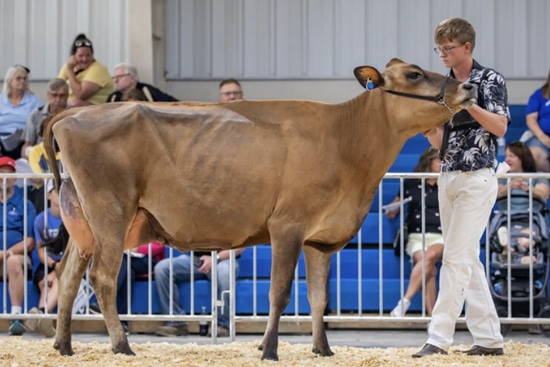
- Eli Staudinger, Reedsville, Wis., with Blue Royal Nu Karoline-ET (Division I, first and overall winner);
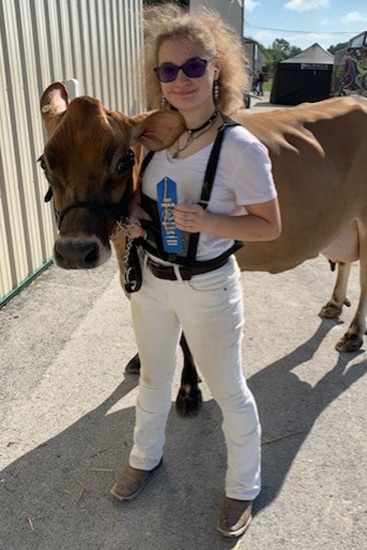
- Erica Neal Stock, Newton, Wis., with JX DoDan Jill Patronus Juleka {6} (Division 1, second);
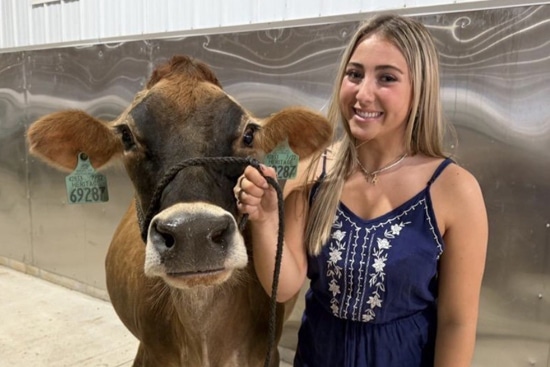
- Hailey Fischer, Cecil, Wis., with Kash-In Heritage 69287-ET (Division I, third; 2026 Pot O’Gold Production Contest, winner);
- Lauren Albright, Willard, Ohio, with JX AJ Corsair 5494 {5}-Twin (Division I, fifth);
- Charlie Tauchen, Bonduel, Wis., with Tauchen Kiawa Enovy-P (Division II, second);
- Addison Fischer, Cecil, Wis., with Kailas Ferdinand Vesper (Division II, third).
Describe your cow that placed in the National Jersey Youth Production Contest.
Eli: My Jersey cow, Karoline, is a daughter of an Excellent-93% full sister to the Reserve Grand Champion of the International Jersey Show held at World Dairy Expo: Rexlea Joel Karausel- ET.
Erica: I named my cow, Juleka, after a character from a show I loved when she was born. Her dam, Jojo, and granddam, Jenny, are both cows from my herd; Juleka’s sire is Patronus. Juleka has a single small white spot on her right flank, and that white spot makes her easy for me to spot in the barn. Juleka is a little independent, but also still very friendly! She just freshened and has a heifer on the farm that is bred.
Hailey: Heritage 69287 is a Jersey that we bought at the Pot of Gold Sale. When we first saw her, we thought she had a lot of potential to be a really good milk cow. Since we got her, she has really shown us what she can do. She milks really well and has become a cow that I’m really proud of. I’ve gotten to watch her produce and see how much she actually contributes to our herd.
Lauren: JX AJ Corsair 5494 is scored Very Good-88%. She is working a second lactation with an m.e. of 28,504 lbs. milk and has a herdmate deviation of 5,051 lbs. milk.
Charlie: Enovy-P is appraised Excellent-90% and her 4-2 record has a dollar value of $6,994.81, which places second in Division II of the 2025 contest. She represents several generations of Tauchen breeding of the “E” cow family.
Addison: Vesper was exhibited as a fall calf at multiple shows, ranging from local to national. When it came to showmanship, she was a first choice; she led herself in the ring. She was easy to work with, laid back, and never ran away when she saw a halter in hand.
What makes her special to you?
Eli: Karoline is special to me, and I chose her because her dam is from a cow family that has great genetics, which I have always been excited about. Karoline’s dam was purchased when the Rexlea herd was sold off in 2021.
Erica: What makes Juleka special to me is that she is one of the few animals I have left from her cow family. Her cow family has also consistently made really good production records in the past.
Hailey: She was my first calf from the Pot Of Gold sale, and seeing her excel was something I really enjoyed. She has shown me how much a good cow can provide and how much work actually goes into getting those results. She is definitely one of the cows that I’ll always remember.
Lauren: She is the daughter of my first 4-H project, Ginger.
Charlie: Knowing she has a great pedigree of production, and her family keeps breeding cows that last and milk well.
Addison: As stated earlier, she was shown throughout the summer and fall. She was exhibited at Northeast Wisconsin High Protein Show, the Shawano County Fair and the open and junior shows at the All American Jersey Show. She placed fifth at the protein show and was Junior Champion of my county fair. She was also a very easy heifer to work with. A lot of time was spent with her to make her lead the best she could, which also made her look her best
If you bought your cow at a sale or from someone else, why did you choose her? If you bred her or if she is from your family farm, what makes the cow family special?
Eli: See above response.
Erica: Juleka was bred on my family’s farm, and what makes her family special is their consistent high production records over the years. As well, she traces back to my great-grandfather’s herd.
Hailey: We bought her at the Pot of Gold Sale because we thought she would make a really good milk cow. We liked what we saw in her and thought she had a lot of potential. Seeing how much she milks has proven we definitely made a good choice. She has been a really good cow for our herd, and we’re excited to see what she can do in the future, along with her offspring.
Lauren: Her dam, Ginger, was scored 87 points and her best lactation was 28,740 lbs. milk. She was very special to me because she was the first heifer I showed at the county fair. Ginger and I won showmanship. Now that Ginger is gone, I keep track of her offspring within the herd.
Charlie: Enovy-P is backed by a special cow family that has placed well in youth production contests. The story is quite funny as I purchased her granddam, Milk-n-More Amazing Eneshia, with my sisters, Abby and India, in the 2014 All American Jersey Sale. Eneshia was bred by my good friends Ron and Nicolle Wussow, also of Cecil. Though she sold in Louisville, she came right back to Cecil. Milk-n-More has housed this cow family for me and I am very thankful for the Wussow family and their years of friendship! Eneshia started the great-producing “E” family for me, which led to her granddaughter Enovy-P placing in the 2025 contest. Her sister, Tauchens Chinook Emery, placed fourth in Division II in the 2024 national production contest.
Addison: The “V” family is special to my family because they come from a long line of bred and owned animals. My cousins exhibited Vesper’s ancestors at local, state and national shows, where they placed well. Her family transmits very well and it is an easy place to look for future show heifers.
What have you learned from keeping records and participating in the contest?
Eli: From participating in the contest, I have learned about many different cow families. From keeping records, I have been able to see different numbers and changes among different cows.
Erica: From participating in the contest, I learned that, much like any contest, perseverance is key. If your animal doesn’t do well in the contest one year, then you can view that as a learning curve. That experience can help you select a bull to breed to the cow to get a calf that will be a better producer than her dam.
Hailey: I’ve learned that records are really important because you can’t always tell how good a cow is just by looking at her. Having her production numbers lets me actually see what she is doing and gives me something to look back on. It has also helped me understand more about the production side of dairy cattle and how the numbers can help with decisions for the herd.
Lauren: We use data from our robots to record production information from our cows. I can look up many different records and reports on PCDart, infoJersey and Horizon.
Charlie: It is important to keep records of my herd to look back on and improve for the future. Participating in the contest has been fun! It is rewarding to see how breeding practices change over time and how my herd has expanded over the past 12-plus years.
Addison: I have learned organization is key to having accurate records. By being organized, I can quickly see and find each animal’s information. The contest has given me an idea of where the highest-producing animals can compete at the national level. It makes me strive to have more high-producing animals in the herd.
Why is it important to collect data like production records?
Eli: I believe that it is important to collect data and keep records because it helps with picking sires and making matings, which can help increase your herd’s average numbers and get higher production. The data and information can help you make your herd successful and improve as your future in the industry continues.
Erica: Keeping records shows you what each animal in a cow family produces, and you can use those records to choose a service sire that will produce offspring with high milk production.
Hailey: Production records are important because they show you what your cows are actually doing. They can help you figure out which cows are producing well and help you make better breeding and herd decisions. It’s a lot easier to make a good decision when you have the actual numbers instead of just guessing. It also gives you something to look back on and compare from year to year.
Lauren: Data like production records can influence breeding decisions within our herd. We use production information to decide which cows to mate to Jersey bulls and which cows are mated to beef bulls.
Charlie: To improve future generations and see the progress made in my herd and the industry.
Addison: I can use the data collected to make sure each generation is improving and better than the previous. By having many generations of bred and owned animals, I can see quite easily the improvements being made from generation to generation.
What are your goals for your cow?
Eli: My goal for Karoline is to get multiple offspring from her with outstanding milk production numbers that will increase my herd’s average numbers.
Erica: My goals for Juleka are to breed her to help grow my herd and to keep that high production record, not just in the cow family, but in my herd as a whole.
Hailey: Our biggest goal for her is to breed her and hopefully have offspring that can milk like she does. We’re hoping her offspring will get some of the same production and qualities that she has. I would love to see her daughters become really good milk cows and continue her family in our herd. It would be really cool to see how much of an impact she can have on our herd in the future from just one purchase.
Lauren: I hope that my cow can continue to be a functioning member of the herd and produce more offspring with superior genetics.
Charlie: Continue to grow my herd and keep producing great-pedigreed and high producing Jersey cattle like the “E” family.
Addison: My goal for Vesper is to keep her genetics and offspring in the herd. It helps me grow my herd. Her family’s genetics are elite compared to more average animals in my herd, so continuing the family is key to having an overall more successful herd.