Candid Discussions on Beef on Dairy and IVF
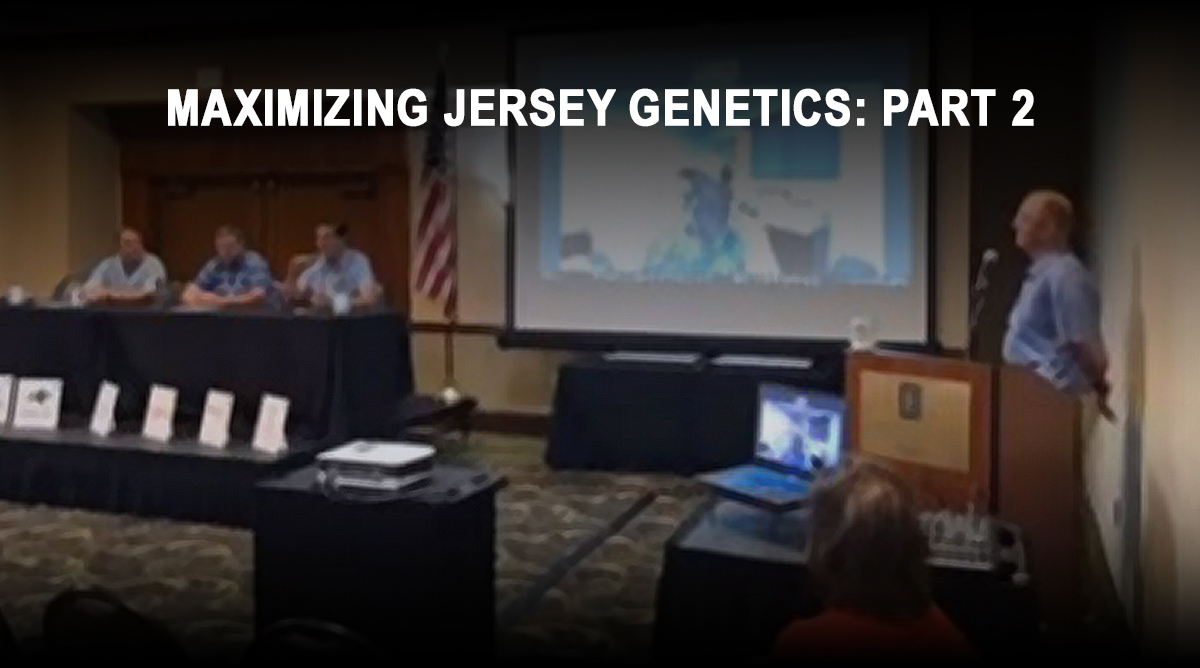
In the second of a three-part series on the panel discussion “Maximizing Jersey Genetics,” four Jersey breeders speak candidly about their beef-on-dairy and in-vitro fertilization (IVF) programs. The four spoke at a session held in conjunction with the annual meetings of the national Jersey organizations at the Embassy Suites-UK Coldstream in Lexington, Ky., on June 26.
The panelists included Joel Albright, Albright Jerseys LLC, Willard, Ohio; Alan Chittenden, Dutch Hollow Farms LLC, Schodack Landing, N.Y.; Cornell Kasbergen, Kash-In Jerseys, Tulare, Calif.; and Brent Wickstrom, Wickstrom Jersey Farm, Hilmar, Calif. The panel was moderated by Brad Barham, Anderson, S.C., with Red-Land Ag LLC, a dairy consulting company that specializes in IVF and embryo transfer programs.
The first of the series was published in the October 2025 issue of the Jersey Journal. The third is planned for the December issue.
Barham: We have talked about sire selection and breed programs. Now, let’s talk about beef-on-dairy. Describe what you are doing now, how you have evolved over the last five years, and whether you use beef embryos or not.
Chittenden: We have been doing beef-on-dairy for six or seven years. We started very small, but as the price of those calves has increased, especially in the last year, so has our use of beef-on-dairy. Conversely, the value of springers and replacements is also strong now. So, right now, we are in the perfect world because both are worth a lot. We are at about 50% of our milking herd matings to beef and are probably even running about 20% of heifer matings to beef. We have limited heifer space here. We have fewer heifers on the ground now than we had 3-4 years ago, with 300 more cows in the barn. We are running about 68% of heifers to cows in the barn right now. For our beef-cross calves, we use SimAngus crosses or straight Angus on the Jerseys. Those calves have been bringing $800-1,000 lately. We do put in a small number of Angus embryos ourselves, and those calves have been bringing $1,200-1,300 at auction. Beef-on-dairy is instant cash, and that has been nice.
Albright: We probably started beef-on-dairy six or seven years ago as well. At this point, about 40% of the milk cows are bred using sorted dairy semen. The rest of the cows are bred using beef semen or are used as recipients. I haven’t bred any heifers using beef semen. But I may start doing that a little bit at the bottom end, especially if we want to make an effort to preserve some of the pure genetics in our herd. We are going to have to reach back into some of those older cow families to get some of that preserved. We may also have to up the percentage of sexed semen on the cows to 50-60%, and mate heifers to beef semen at a rate of 10-20% to keep the inventories the same. We shoot for 50% over the number of heifers we need to keep each month. That gives us some to wean off the bottom. There are a variety of environmental challenges, and this gives us a little cushion. It is also nice for a herd of our size to have 20 really nice calves every month to go into a replacement program. We have implanted a few beef embryos, but not a ton. Once those are born, we will be able to prove that out for ourselves. Most of our beef cattle go directly to customers or are picked up at the farm. We keep creeping the price up, but we are probably not getting enough for them.
Kasbergen: We are breeding about 50% of our herd as beef-on-dairy. Everything is genotyped, and the bottom end, based on genomic evaluations, is bred to beef semen. We use Charolais semen on some animals and Angus embryos on others. We implant about 100 Angus embryos every week and are getting about 62% conception on those. We time-A.I. everything, giving shots on one Thursday and implanting embryos the following Thursday. We implant beef embryos one week and Jersey embryos the following week. We are getting $800 for pure Angus embryos, but the Charolais calves have been creeping up. They were at $300 and are now approaching $500-600. They are getting closer, and the market is moving all the time.
Wickstrom: We are breeding about 40% of our cows to sexed Jersey semen for the first two services. The rest are bred using either a stabilizer cross or implanted with Angus embryos. We are probably putting in about 50-70 Angus embryos a month. For our cross calves, we are getting $450 right now, about halfway through our contract. For pure Angus calves, we are getting $700. We have a deal, though, where we don’t pay for the embryos or the transfers. We kind of take that off the back end. We have been doing beef-on-dairy for about six years. It is a way to create the females we need as replacements. We shoot for a ratio of about 90-100% of heifers to cows. I like to have a few extra heifers, so we have some wiggle room if we run a high death loss on heifers or need to grow a little bit. We also do a lot of video sales of fresh, first-lactation heifers, so we want some room for that. We were into Wagyu before the stabilizers and getting about half of what we are getting now. We signed a contract for two years, and now the price has gone even further beyond that. It is kind of crazy out here, watching the beef thing going up and trying to find the top.
Barham: Do you use IVF, and if so, why do you size your program as you do? How do you see value in IVF for a herd of your size?
Albright: We were a cooperator herd for a bull stud, so we implanted close to 200 embryos for them in an 18-month stretch of time. That was a really good learning experience for me from the standpoint of seeing how low the success rate was for making bulls or really elite females. They hauled off our farm fewer than 10 live animals that they decided were good enough to take into their program. When I started penciling the numbers out, I just didn’t think we were in a position to invest our resources in IVF at that time. We have had some high-numbered animals and our JPI herd average is fairly high, but we have pretty much done that through population genetics at this point. Right, wrong, indifferent, that is what we do.
Chittenden: Our IVF has maybe picked up a little in the last few years because we have had a facility that was much closer to us, and that was handy. For quite a while, we didn’t have any elite genomic animals that I wanted to work with. Sometimes, we had animals that were high-genomic, but when I went back and looked at them, they didn’t thrill me. The conservative part of me says, “I’m not going to go all in flushing this heifer if I’m not wild about her.” In the last couple of years, though, we have had a couple that have been higher up those charts. I have been more excited about them, so we have been all-in. Also, as I said earlier, I believe in genomics, but not 100%. Some of those genomic animals that are supposed to be special don’t turn out to be that special. Whereas good solid cows from good solid cow families that I see in front of me, I know how I want to mate them and those are easier to work with.
One thing I would like to add is that our IVF program grew last year for a couple of reasons. First, my son-in-law is implanting them himself, so he can implant them at any time based on any heat. Second, the herd has been pretty much switched over to a synced program here in the last year. When they are all coming into heat on one day, it is much easier to line up a group of recipients and have a professional come in and do it if that is the route we want to take. So that has changed the situation and made it much easier to look at doing more IVF.
Kasbergen: I see IVF as a way to build value in the genetics of the herd. We have been able to justify it with bull sales and some of the heifer sales. We have been able to generate sales that cover the cost of the IVF work. We are continuing to build value and the top end of the herd. It is something we have a passion for. It is also something we fell into accidentally. When we bought the Jars of Clay herd, there was a special polled cow in the group. We sold some bulls to Select Sires out of her that ended up being polled. And we had several polled cows and heifers from the family ranked in the top 100 on the polled list. That propelled everything. We continued to IVF, and we continue to have success with creating high genomic animals. For us, IVF is both a hobby and a business, and we try to treat it as such. The show cows get a little harder to justify, but when you roll it all together we can justify the investment.
Wickstrom: When I came home from college in 2013, genomics was kind of new. My dad was playing around with it, and we had a couple of heifers at TransOva. When I started digging into the production differences on the top 20% of the cows and saw differences of nearly 2,500 pounds of milk per lactation, we started working with more donor dams. That was about the time Cornell put his IVF facility in Tulare, so I was hauling animals down there. As that was wrapping up, TransOva wanted a facility in our area, so we put one here. At that point, we were using all sexed semen to build our base. We had good genetics after decades of breeding but wanted to get to an elite level. About five years ago, we were at a point where we wanted to put bulls in stud so we started using more conventional semen. kind of at the point we could start doing more conventional trying to put bulls into studs. Before that, we were just buying it off heifer sales and production on the cows once they got to the milk barn. In the last 4-5 years, we have been able to focus more on making some bulls. We hired a consultant to help with that. And as Joel said, that side is a little trickier. You do a lot of work to send a couple of bulls a year, and hopefully they live long enough to make some semen. We started focusing more on getting deeper into the matings to try to chase that game. And, like Cornell said, it is a passion too. When I came home, I was really into genetics, and I still am. I saw potential to make better cows as a start, and now, I think we are close to having 35-40 females on the top 500 list right now. And I think we are close to having 30 on the list of the top 500 Herd Register females too. We are really seeing the results. While I don’t know exactly where we were 10 years ago production-wise, IVF is definitely working in that aspect too.
Attendee Question: Has the average age of your herd gone up with beef-on-dairy and other things you are doing?
Chittenden: I don’t think ours has changed that much. I guess what has changed is that we don’t have the surplus heifers coming along that we used to, so we just don’t sell as many replacements here and there. We keep all of them for ourselves. I don’t think our average age has stayed steady.
Albright: I don’t think we have really gotten a lot older. We have probably gotten a little younger. We milk with robots, so some of the cows with deep udders, we are intentional about marking as “don’t breed backs,” so they are planned culls. If we have a cow that is on the fringe of not being milkable, she gets marked DNB (do not breed). We plan for about 10-15% of our cows as DNBs. And with nearly every sixth or seventh lactation cow, somebody is putting eyes on her to make sure she is special enough not to get marked as DNB.
Kasbergen: I’d say in our herd, the average age may have gotten a little older, just because the genetics are better and the breedings are better. Hopefully that trend continues.
Wickstrom: We have probably gotten a little older just from the beef semen usage and keeping those older cows around longer and getting bred back more quickly. And then we are not raising as many heifers, and we are not culling as many. So that has made our herd a little older, too. Though the bird flu might have knocked us back down a little bit, we have been pretty consistent.