Trends, Emerging Challenges for Jersey Breed
In his presentation at the Annual Meeting of the American Jersey Cattle Association (AJCA), Executive Secretary Neal Smith examined recent trends in the dairy industry, describing how the industry arrived at its current state. Speaking in late June in Lexington, Ky., he also illustrated how the organization’s responses to challenges have shaped the breed’s success over the past century.
Smith began with an overview of registrations—arguably the litmus test for success across the past 100 years.
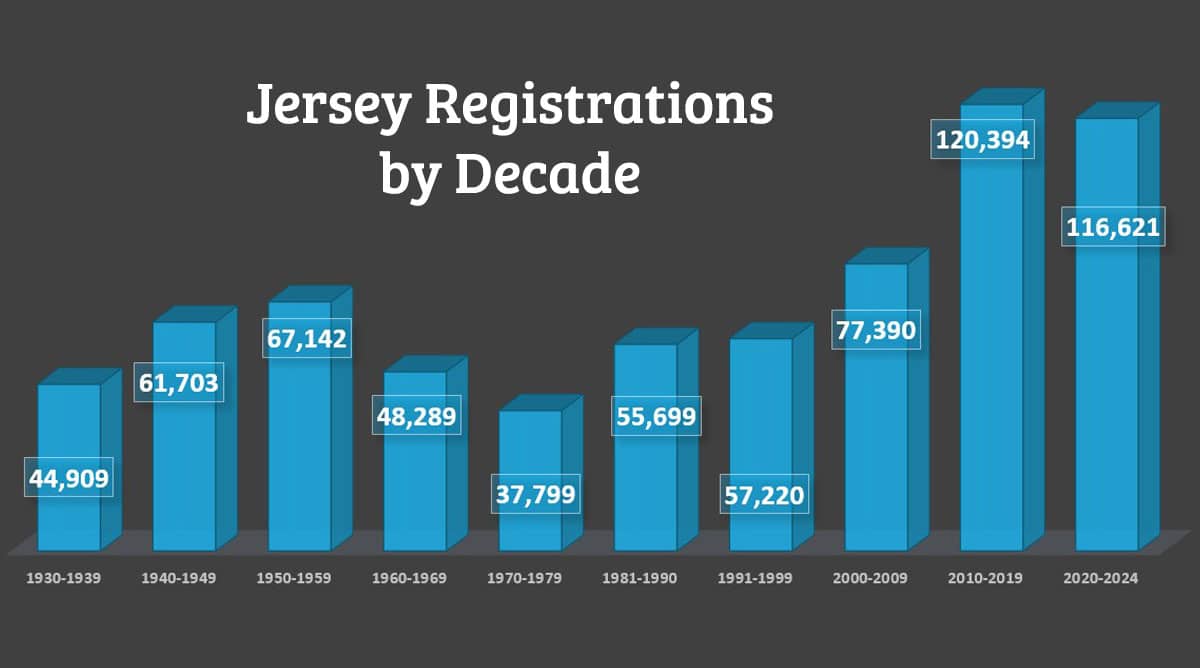
Registrations in the ‘30s, ’40s, and ‘50s were relatively stable, Smith noted, but plummeted to about 38,000 per year on average in the 1970s. They steadily climbed over the next four decades, peaking in the 2010s with more than 120,000.
While we enjoyed about 15 years of high registrations, we are starting to trend down a bit, with about 116,000 registrations on average over the past four years, Smith remarked.
“Several factors may be influencing that,” he said. “For about three decades—from the ‘90s forward—we enjoyed consistent growth in performance program enrollment, which led to consistent registration growth. Then, sexed semen kicked in during the 2010s, and we really started to climb.”
We are beginning to see new trends affecting registrations, Smith noted. These trends are not unique to Jersey, as other breed associations are facing similar challenges.
Part of this shift may be tied to the adoption of highly automated equipment. While this technology collects data, some producers opt out of participating in the industry’s data collection infrastructure. And while sexed semen initially boosted registrations by producing more female calves, producers are now managing their herds differently with the technology and making only the replacements they need, with little excess. Beef-on-dairy matings are also yielding fewer dairy heifers.
Standout Moments of the Jersey Breed
Smith said that Jersey businesses are impacted—both positively and negatively—by decisions made by the dairy industry as a whole and entities outside industry circles.
In a graphic, he showed how Jersey leaders have responded to some of these decisions over the past 100 years.
In 1935—in the years following the Great Depression and before World War II—the Jersey breed represented 42% of the U.S. dairy cow population; Guernsey accounted for another 40%.
By the 1940s, breed shifts began to occur, and Jersey registrations dipped. The turning point was a decision by the federal government regarding milk, a primary food source for the U.S. military. When soldiers were asked if they could tolerate 3.5% milk, their “yes” response was the day we moved from higher-fat milk to 3.5% fat milk as a standard, summed Smith.
Jersey registrations recovered slightly during a pair of post-war catch-up programs: one in 1947 and another in 1953, in which a longstanding record of 87,682 registrations was posted.
“The ‘60s and ‘70s, we can sum up as the time the dairy industry began to question the profitability of the Jersey cow,” said Smith. “We bottomed out in 1973 with only 33,000 registrations.”
Desirable conformation displayed as the “ideal” Jersey cow has mirrored this change over the years, remarked Smith.
“In 1925, we had one wet little machine,” he noted. “You might see her as a 20,000-pound cow of today. She was dairy but didn’t have a pretty udder.”
The board decided they could give up some production to fix the udder, so the next version had a shapelier udder, but her structure moved away from the open-ribbed, flat-boned, big-muzzled cow of 1925. The third version of the ideal cow, from the 1970s, had a nearly perfect udder, but was far smaller and less dairy than her counterparts, with ribs barely showing in a side view.
The two most recent ideal cows, painted by Bonnie Mohr, represent the modern Jersey.
“You changed the way you bred your cows for production and performance,” Smith commented. “We have moved forward and made a lot of progress in the last 4-5 decades.”
Several key programs have been adopted by the national Jersey organizations since the mid-1970s, too, including Project Equity and Genetic Recovery in 1976, REAP in 1994 and Jersey Expansion in 1997.
Jersey Marketing Service (JMS) was introduced in 1977 as a response to dismal registration numbers.
“The board knew we had to do something,” explained Smith. “At that time, we struggled to get marketers and auction companies to pay much attention to the Jersey cow because she was not in demand. The board said, ‘We are going to have to market them ourselves,’ and began to develop JMS.”
“Today is a different picture. There are a lot of auction companies happy to market Jersey cows because they have value.”
Genetic advancements have also influenced the dairy industry over the years.
“Predicted Difference (PD) evaluations, adopted by the entire dairy industry in 1968, made a big impact,” said Smith. “There was resistance initially to PDs because registered breeders were able to sell all their bull calves as breeding bulls at that time. And while A.I. had been introduced, it was not yet prevalent.”
As A.I. gained a stronghold, the Jersey organizations worked with A.I. companies to identify Jersey sires and genetic lines that would influence production, remarked Smith. That led to the use of high-production bulls like J. S. Quicksilver Royal, Milestones Generator and Observer Chocolate Soldier, and increased demand for Jersey cows by commercial dairy producers.
Decisions by the federal government have also played a role in Jersey registrations and demand for Jersey cattle. The adoption of multiple component pricing in Federal Milk Marketing Orders in 2000 created tremendous demand for Jerseys. More recently, the removal of whole milk and 2% milk from the school lunch program in 2012 has negatively impacted Jersey producers. On the flip side, the Food and Drug Administration’s ban of artificial trans fats from the food supply in 2018 has bolstered high-fat milk consumption.
Developing Trends
Jersey registrations peaked in 2017 at 184,957, noted Smith. This was followed by the next two highest years in breed history, with 132,116 registrations in 2018 and 132,318 in 2019.

Peak years of Jersey registrations coincided with peaks in domestic sales of Jersey semen. According to the National Association of Animal Breeders (NAAB), a record 3.4 million units of Jersey semen were sold in 2017, followed by 3.2 million units in 2018. Last year, this number dropped to just under 2.1 million units. In 2017, Jersey accounted for 15% of all domestic dairy semen sales; today, that number is about 13%.
“The numbers are dropping a little bit each year,” said Smith. “This is where we see dairy producers making decisions to capture the value of beef calves. This has an unintended negative consequence on registrations. Dairy producers are just not making as many heifer calves.”
What changed on the male side of the equation? In 2017, the NAAB reported domestic beef semen sales to be 2.5 million units. By 2024, beef semen sales nearly quadrupled to just under 10 million units. The increase wasn’t being used on beef females, but rather dairy females.

Although there have been shifts in beef breeds used as service sires, Angus is the leader by far. In the past two years, gains have been made by Simmental, Charolais and crossbreds, along with hetrospermatic (pooled) breedings. These shifts are probably related to the contracts some of the larger herds can make to get the best bang for their buck from the beef on dairy market, said Smith.
It is this combination of sexed semen and beef on dairy that creates the perfect storm for decreased registrations, summed Smith.
The dairy industry is now essentially operating under “unintended” supply management, even though it has been under voluntary supply management for decades.
“We do not have millions of replacement heifers available, so the price of cows goes up,” said Smith. And because the national beef herd is relatively small, cull cow prices remain strong.
“This type of supply management will continue as long as beef demand continues,” Smith said.
Consolidation continues to affect the dairy industry, too. In 2003, there were 70,000 licensed dairies; today, that number stands just under 25,000. Cow count remains stable, however, with 9.1 million cows in 2003 and 9.3 million today. In other words, herd sizes are increasing dramatically.
The AJCA navigates changes and creates influence through entities like National All-Jersey Inc., JMS, breed-sponsored events like the annual meetings and the All American, and youth programs like Jersey Youth Academy, noted Smith.
Smith cited the AJCA’s type appraisal program as an example of adapting and exerting influence. The program is guided by the Type Advisory Committee, a group of five Jersey breeders from different-sized herds across the country, the Breed Improvement Committee chair, a technical advisor and an A.I. representative.
“If we didn’t change this cow, we would not have a room full of folks like we have today,” Smith remarked. “She had to change, and that has been key.”
Developing these building blocks of stability will remain essential for the for the Jersey cow and her caretakers, Smith concluded.
He closed his presentation with a graphic affirming the national Jersey organizations’ commitment to “Be Your Best” by delivering customer service that is personalized, competent, convenient and proactive.