Jersey Producer Panel Discusses Sire Selection, Breed Programs
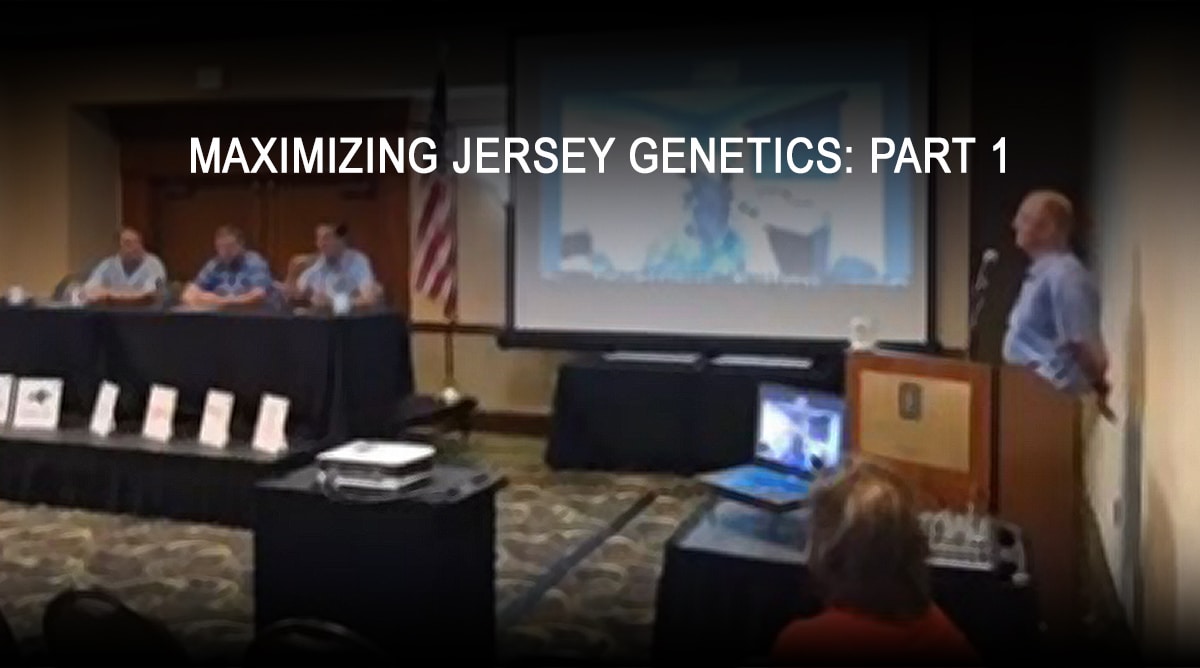
Jersey breeders attending the annual meetings of the national Jersey organizations learned about the breeding programs of four of their peers in a panel discussion held at the Embassy Suites-UK Coldstream in Lexington, Ky., on June 26. The panelists—Joel Albright of Willard, Ohio, Alan Chittenden of Schodack Landing, N.Y., and Californians Cornell Kasbergen of Tulare and Brent Wickstrom of Hilmar—spoke openly about a variety of topics from sire selection to beef-on-dairy and new technology. The discussion, “Maximizing Jersey Genetics,” was moderated by Brad Barham.
The four Jersey breeders—with varying management styles and herd sizes—kicked off the program with a frank discussion about sire selection in the era of Generation Count and the “JX” prefix and their use of the Jersey association’s programs and services. Their responses are highlighted below their introductions. The balance of the program will be featured in the next two issues of the Jersey Journal.
Joel Albright, Albright Jerseys LLC: Albright operates the 600-cow Registered Jersey herd with his wife, Mary Beth, and their children, Lauren and Luke, and his parents, Fred and Becky. Cows have been milked by nine Lely A4 robots since 2018. The herd is enrolled on REAP, uses JerseyTags and JerseyMate and advertises with the Jersey Journal. The herd has a 2024 actual herd average of 21,520 lbs. milk, 1,071 lbs. fat and 781 lbs. protein, marks that rank first for milk, fifth for fat and fourth for protein nationally among herds with 300-749 cows. Albright Jerseys ranks #18 nationally for genetic merit with a herd average JPI of +77 (August). The herd was a virtual farm tour for World Dairy Expo in 2019. Albright is currently a director for National All-Jersey Inc. and previously served two terms as a director of the American Jersey Cattle Association (AJCA). He was general chair of the All American in 2023 and received the AJCA Young Jersey Breeder award in 2016.
Alan Chittenden, Dutch Hollow Farm LLC: The Chittenden family has been breeding Registered Jerseys since 1919. The farm today includes three generations of partners managing 1,000 cows and 700 replacements and farming 2,000 acres of cropland. Dutch Hollow has contributed to Project Equity since 1977 and been enrolled on REAP since 1997. The farm uses JerseyTags, maintains a website on JerseySites.com and has advertised with the Jersey Journal since 1980. The dairy is a member of Agri-Mark and joined with 11 other farms to also market milk under the Hudson Valley Fresh label. Milk is also sold to High Lawn Farm and Mapleline Farm in Massachusetts and Four Fat Fowl in New York. Dutch Hollow Farm was named AJCA Master Breeder in 2012. Cows are milked in a double-15 herringbone parlor. Chittenden is serving his fourth term as AJCA president and is a former AJCA director as well. He won the National Jersey Youth Achievement Contest in 1988 and received the AJCA Young Jersey Breeder award with his wife, Donna, in 2000. Their daughters, Emily and Lydia, won the youth achievement contest as well.
Cornell Kasbergen, Rancho Teresita Dairy/Kash-In Jerseys: Kasbergen owns and operates the farm with his wife, Teri, and their son and daughter-in-law, Case and Allison. family. The milking string includes 3,700 Jerseys, 750 Holsteins and 600 F1 crosses. The Jersey herd is enrolled on REAP and has a 2024 actual herd average of 20,313 lbs. milk, 1,075 lbs. fat and 761 lbs. protein. Kasbergen has been involved with Jerseys since 2011, when he purchased the Jars of Clay herd from the Quist family of Fresno, Calif. The Kasbergens undertook an extensive in vitro fertilization (IVF) program using the Quist cattle and other foundation animals from Brentwood Farms, Orland, Calif., and Sunset Canyon Jerseys, Beaver, Ore. A TransOva satellite center was established at the farm in the mid-2000s. About 55 bulls have been placed in A.I., including Kash-In Slugger-P-ET, syndicated at the 2015 All American Jersey Sale for $120,000, a breed record at the time. The family hosted the Kash-In on Valentine’s Day sale in 2018, which averaged $12,548 on 61 Jersey lots, and the Decades of Dupat sale with the Wickstrom family in 2023. That sale averaged $10,829.29 and grossed more than $1 million. The Kasbergens partnered with Carly and Rebecca Shaw in showing the winner of the 2022 National Jersey Jug Futurity, Budjon-Vail Jordan Shaneese. Kasbergen is serving his second term as an AJCA director. He chairs the organization’s finance committee and is an ex officio member of the NAJ board.
Brent Wickstrom, Wickstrom Jersey Farms Inc.: The Wickstrom family has been milking Jerseys since 1973 and breeding cattle with the DuPat prefix, named for the founders, the late Duane and Pat Wickstrom. Today, their sons, Scott and Mike, and grandsons, Steven and Brent, operate the business. Brent manages the home dairy where 2,600 Jerseys are milked in a rotary parlor. He and his father, Mike, also own Pinnacle Dairy, where 1,200 Jerseys are milked in a double-16 parallel parlor. Mike and Scott partner with Brad Nyman in Red Top Jerseys in Chowcillo, Calif., where 6,300 Jerseys are milked in two rotary parlors. All farms are enrolled on REAP. The home dairy ranks #5 nationally for genetic merit with a herd average JPI of +87. Both Red Top and Pinnacle rank among the top 35 nationally as well. Wickstrom Jersey Farm and Red Top Jerseys both have 2024 actual herd averages over 21,400 lbs. milk, 1,50 lbs. fat and 800 lbs. protein; Pinnacles has an average over 19,500 lbs. milk, 950 lbs. fat and 735 lbs. protein. Wickstrom Jersey Farms is a founding member of Jerseyland Sires and a Trans Ova satellite, too. Mike, Scott and Brent have all received the AJCA Young Jersey Breeder award and Duane was named AJCA Master Breeder in 2002.
Brad Barham, Anderson, S.C.: Barham grew up on a 200-head Registered Jersey dairy in southeast Tennessee and earned an undergraduate degree in business management and finance. He was a member of the inaugural Jersey Youth Academy in 2008 and launched his professional career working for the AJCA. He has also held roles with River Valley Farm and All West Select Sires and is now the southern regional sales manager for Premier Select Sires. He and his wife, Iris, own and operate Red-Land Ag LLC, a dairy consulting company that specializes in vitro fertilization (IVF) and embryo transfer programs.
Barham: Let’s start the conversation by talking about sire selection. Have there been changes in your program and the traits you consider over the years?
Wickstrom: In our area, it has been hard to expand, outside of buying a neighborhood. Since I came home from college about 12 years ago, our focus has been on getting as much milk as we can out of each cow. We ship to a cheese plant, so that kind of puts those two things together. We focus a lot on Cheese Merit Dollars and production traits. The biggest change for us in the last couple of years has probably been the (Generation Count) brackets. We have been trying to use just fives, sixes and HRs (Herd Register). That translates to our IVF program, too, and we strive to make HR animals that still produce well. We probably use 70% sexed dairy semen and 30% conventional semen. Right now, we are pushing a herd average of 90-95 pounds of energy-corrected milk every day, year-round. Since we ship to a cheese plant, our driver has been production, while also maintaining components. That is how we get paid.
Kasbergen: I would say on our program, we are using probably 70-80% young sires. But after listening to John Metger this week, it might be the other way around with what is going on with proven bulls versus young sires and their real reliabilities. But I think young sires have served us well. We use a fair amount of them and try to pick bulls that sire great udders and good production, and are solid cows. I would say that is what we are focusing on.
Chittenden: Over the years, we have always been strong young sire users. If you go way back to the days of New England Jersey Sires and Liberty Jersey Sires and All American bulls, we have always bought in on young sire sampling. The need for and value of young sire sampling was diminished by the introduction of genomics. When I am picking sires today, I want balance. I start with the JPI list and then start throwing out the ones I don’t like. I don’t tolerate too low a JUI (Jersey Udder Index) score. I want a good, functional cow with good udders. I also stay away from cows or bulls that are extremely low in components. I feel like I’ve worked too hard over the years to get those percentages up there, and I don’t want to just give it away. So a ton of milk bull with extremely low components doesn’t thrill me. I would rather have the 1,000-pound bull with good, balanced components and good, balanced type. And we never went all in on some of the JX. We stayed away from the extremely low brackets. If I see a “bracket bull” with the bracket coming from just one part of the pedigree, I am okay with it. When I see it coming from all four grandparents, I tend to stay away from it. I am not completely selective, but somewhat selective. Then certainly over the years, we have made exceptions for the polled factor. That has always been the lifeblood of my family. I didn’t always use it as much as my dad or my grandfather did, but I kept it alive. It has paid dividends to us over the years.
Albright: We have used quite a lot of genomic bulls. To manage the risk, we try to use a good cross section of them and not use too much of any one young sire in case they go the other way on us. We are now probably shifting back to more proven bulls. That is somewhat of a function of the fact that we currently have some really good proven bull options available to us. Like Alan said, we use higher JUI bulls that are probably above breed average as a cut-off. There are times that we have used some proven bulls that are lower JUI when we know for sure what we are going to get. I feel that typically, the udders of proven bulls have been a little bit better than what we see on paper, and we are not disappointed. Whereas some of the genomic bulls with really high udder indexes have not always lived up to their rating.
Barham: We are at the national Jersey organization meetings, so let’s talk a little bit about the Jersey programs you use and what you get out of them.
Kasbergen: The biggest benefit for us being on REAP is the appraisal program. This is valuable for us, not just for the information, but because it is the time we get to see the cows. Twice a year, we get to see what is going on in the herd. When we go through the cows, we try to find cows that are really high production, really high type, and have a great pedigree. Some of these cows might be in their third or fourth lactation and have four or five generations of Very Good or Excellent dams with very good production. We are IVFing those cows and making genetics that can hopefully be a bull mother down the road. We think appraisal scores build pedigrees. There is a lot of value in that. We have some breeders who are quitting, and I think they are just throwing that away. I think they are throwing away an opportunity. As well, all our pedigrees are dumped into DairyComp. That is a huge plus. We don’t have to go anywhere to find pedigrees. They are all sitting there on the computer. There is a lot of value there and it is a great program.
Chittenden: I would echo what Cornell said. I can’t tell you how many nights I fall asleep upstairs in front of the computer just browsing through infoJersey or another program, looking at pedigrees and digging things up. As well, if I am going to sit in this position (as AJCA president), I am going to have to talk the talk and walk the walk. We have always been strong supporters of Jersey programs. We have helped to create them, so we’d better follow through with them. When we market cattle, they often head across the border into Canada or go to an elite sale. For us, it is easier to have that information ready rather than letting the pedigree go and having to go back and update it. Have we actually pushed the pencil on the whole thing? I would say no. We just believe in it and follow it. We enjoy the appraisal part too. We enjoy having those pedigrees and support the programs.
Albright: Alan mentioned infoJersey. That is probably the part I dig into the most. It gives you a really good tool to sort your herd and create spreadsheets. You can put in your own selection criteria, say, if you are trying to find females that meet a certain cut-off to do different things with. For example, if your field rep calls and wants a consignment, you can quickly generate a short list and go out and find those animals to make sure they look the part. Or, if you do want to do some IVF work, it is an opportunity to start sorting that out. I also use it to sort my bottom, like for a group of calves we recently merchandised. Every day you have them on feed, it costs you money. The sooner you move them down the road, the better. I probably use infoJersey and HerdView to help me sort the bottom end as much as I do the top end.
Wickstrom: We have REAP on all three facilities and I appreciate how it is all tied together. We appraise every cow, and it is amazing how many good cows we find that we didn’t know were there. And then how that ties in, I use JerseyMate for all our matings. Especially with as much beef semen as we use, I really want those animals we are putting Jersey sexed semen in to make good calves. The last couple of years, Herby Lutz has complimented us on how uniform our first lactation groups are. I credit that to using a mating program, appraising cows and getting the right bulls mated to those cows. With the volume we have, we can’t hand-mate every cow to certain bulls as corrective matings. We do the best we can on a volume basis. I really credit those programs for getting us uniform animals and trying to correct problems on a big scale. And, as Cornell said, having the guys here to appraise cows twice a year gives you a chance to walk all the cows. You find some really nice ones that might not be your top genetic ones, JPI- or production-wise. But there is something you can work with, using bulls that work with the genetics of those nicer cow families that have some history behind them.
Attendee Question: The mating program sounds terrific in theory. But do you have semen in the tank quickly enough to be able to do what the program says you are supposed to do? Do you see if the semen is available first? And do you use bulls from across all studs, or just focus on one stud?
Chittenden: Personally, I have never used a mating program. I am still old school. I still see my cows. I still make individual matings. My son-in-law may also make matings, though not quite as often, by reviewing pedigrees. There are only a couple of studs that we really work with. Some of them have gone all in on some of the JX bulls, so I haven’t followed their programs.
Albright: Every time the bull proofs come out, the first thing you can do is figure out what is available to you, and then you can get your inventory. We adjust our JerseyMate group to our inventory probably monthly to make sure that we have just what is in the tank is in our matings. Then we put that into PCDart at our place to keep those matings really current to what we have in inventory for the guys breeding the cows.
Kasbergen: We mate all IVFs based on their pedigrees. The rest of the cows, we don’t mate individually. We try to use balanced bulls that are not extreme in strength or really dairy. This seems to work for us. All first-lactation heifers are grouped together, and then second- and third-lactation cows are grouped together as well.
Wickstrom: We usually have about eight bulls in the matings at a time, bulls we know we are going to have a consistent inventory on. We remate the herd quarterly. When the technicians are breeding, they have handhelds that determine whether an animal will get sexed semen or beef semen. If she is getting sexed semen, the program gives a #1 sire and a #2 sire. If we are out of sire #1, they can use sire #2. It is not always perfect, so we do have to stay on top of things for parentage, as Cornell stated. When they are entering readings into DairyComp, sire #1 and sire #2 are listed. So it is usually just a matter of clicking button one or button two if she was bred to one of them. We have avoided a lot of those problems there because there is not a whole lot of typing. As well, being a Jerseyland herd, there are days when we have a big ovsynch day and just one young sire is used for the day across all cows bred that day. That is not a perfect system either, but we try to mate them as closely as we can. We are using mostly Select Sires bulls because we partner with them for Jerseyland. But we do try to use everybody a little bit when we can get their bulls to diversify a little bit.