Working Together to Build the Jersey Breed’s Future
A synopsis of the presentation Neal Smith, executive secretary and CEO, presented to members of the American Jersey Cattle Association at the annual meeting on June 18, 2026, in Springfield, Mo.
As I stand before you today, I realize this will likely be my last opportunity to address the membership face-to-face. It is a bittersweet moment.
People ask, “What’s next for Jerseys?” The honest answer is that we think we’re ready—we hope we’re ready.
Looking back, I’ve always believed the Jersey cow responds when we challenge her. When we said we needed more milk, we bred for more milk, and we got more milk.
We’ve come a long way since I was growing up in Mississippi in the 1970s. Back then, Dad had the state’s highest-producing Jersey herd at 10,000 lbs. of milk, and our state ranked fifth in the nation for Jersey registrations.

The Jersey cow has responded to every challenge we’ve given her, and I believe she can meet the next ones as well.
There have been many programs and milestones that advanced the breed over the years. But what stands out most to me is that we worked together to achieve common goals. We came together and said, “Let’s get it done.” That has always been key.
Today, we need that same spirit of working together more than ever. We are a smaller breed, and our numbers continue to decline. We cannot afford to pull in different directions. Our strength has always been our willingness to unite behind what is best for Jerseys.
The opportunities ahead are significant. Demand for protein continues to grow and the return of higher-fat milk to the school lunch program is encouraging. But just because the law changed doesn’t mean success will happen automatically. We’ll have to help make it happen.
We need to continue to challenge the Jersey cow. If we focus on increasing pounds of protein while maintaining fitness traits, we can make Jerseys even more profitable.
History reminds us that progress requires courage. Every period of growth has been driven by people willing to make difficult decisions.
In 1935, Jerseys represented about 42% of the dairy cows in the United States. There were also challenging times, including the early 1970s, when registrations dropped to around 33,000. Reversing that decline required the same kind of courage to change course. Across our history, Jersey-led programs, like Jersey Creamline, All-Jersey, Project Equity, Jersey Marketing Service and Genetic Recovery, helped move the breed forward. Industry-wide changes, including Federal Order Reform, also created opportunities for Jersey growth.
None of those advances happened without courageous leadership. Time and again, directors were willing to say, “This isn’t working. We need to fix it.” That willingness to make difficult decisions has been a major reason for our success, and future boards will need that same courage.
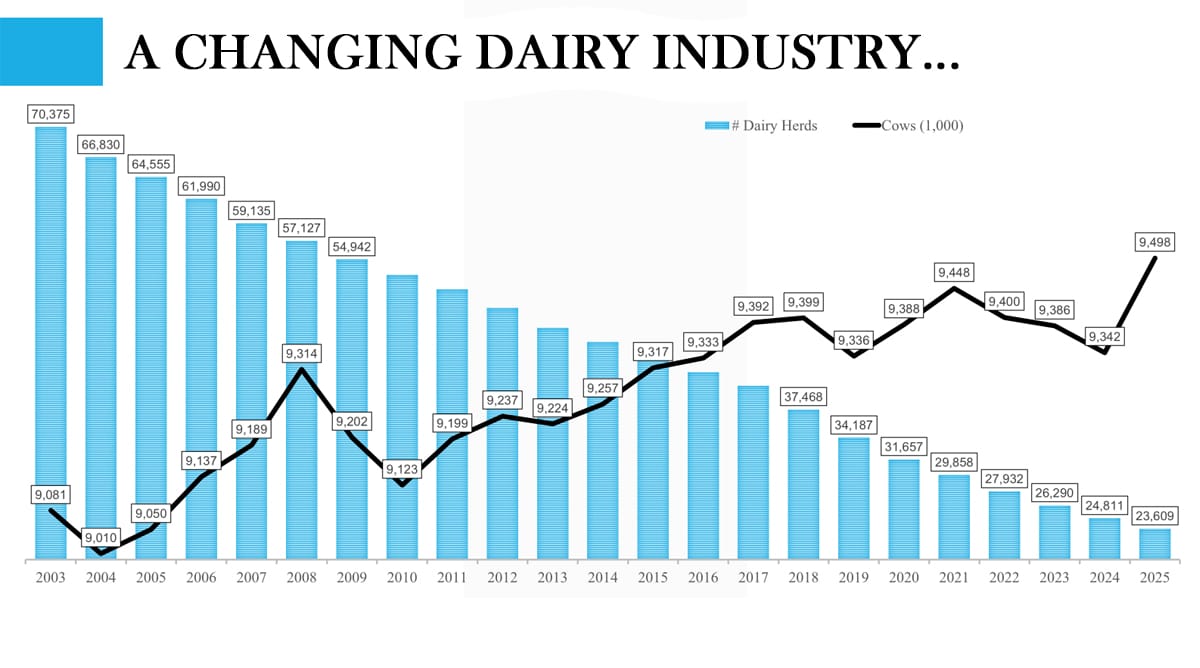
The industry itself has changed dramatically. The number of licensed dairy farms has fallen from about 70,000 in 2003 to fewer than 24,000 today, while the national dairy cow population has remained stable at about 9 million. Consolidation, sexed semen, beef-on-dairy breeding, genomics and advancing technology have all reshaped registration trends and breeding strategies. While these shifts have reduced registrations across all dairy breeds, they have also accelerated genetic progress.
Genomics has been one of the most powerful advances in that progress, giving breeders better information to make smarter breeding decisions. Yet the numbers tell us we still have work to do.
That becomes clear when we compare production levels across breeds.
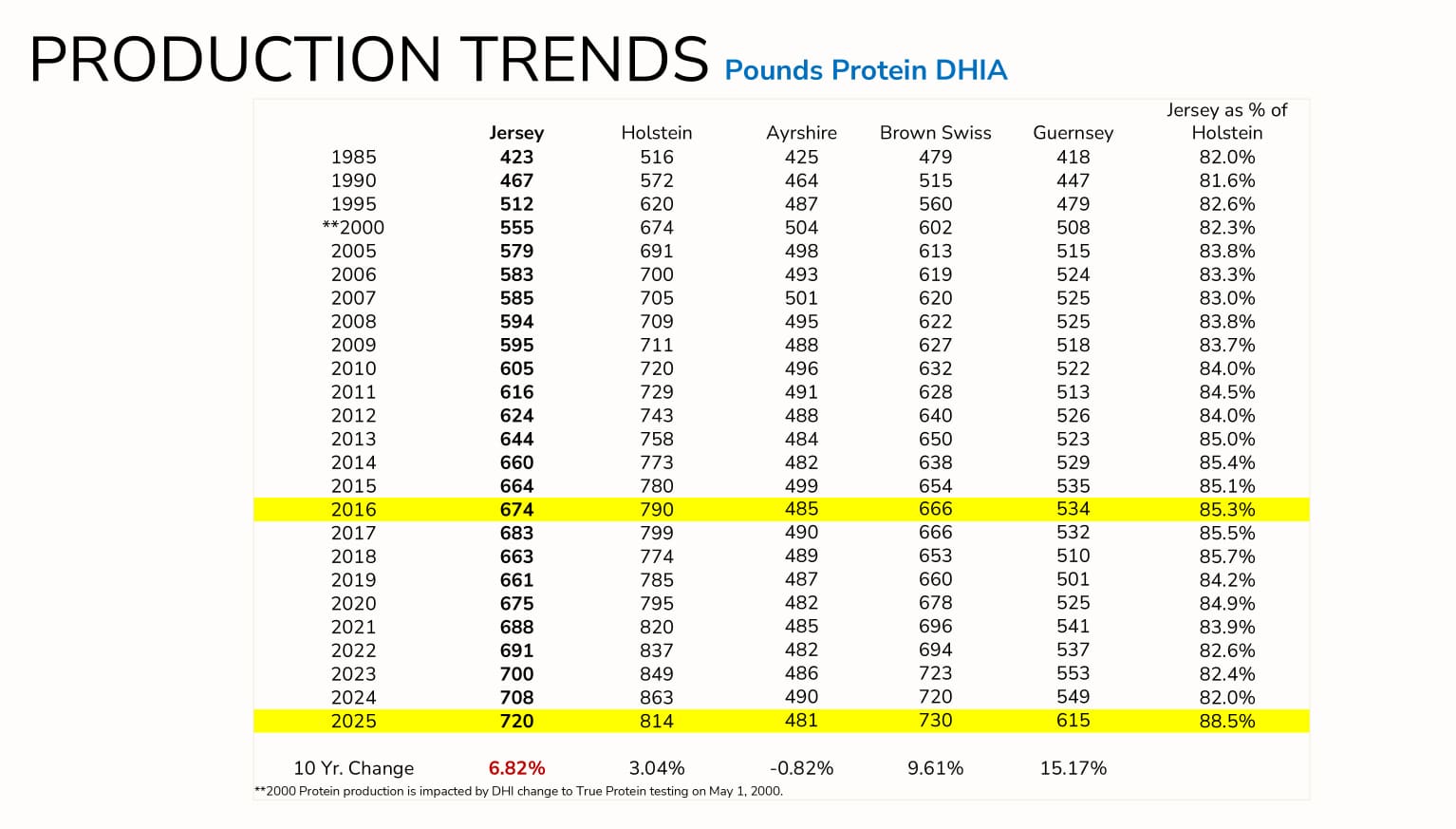
Jerseys average 720 lbs. of protein, compared to 730 lbs. for Brown Swiss and 814 lbs. for Holsteins. For fat production, Jerseys average 968 lbs., while Holsteins average 1,165 lbs. and Brown Swiss average 894 lbs.
Over the past decade, Jersey protein production has increased 6.8%, compared to 3.0% for Holsteins and 9.6% for Brown Swiss. Jersey fat production is up 9.6%, while Holsteins have increased 23.2% and Brown Swiss 10.6%. Guernseys have increased protein and fat production by more than 12% during that period.
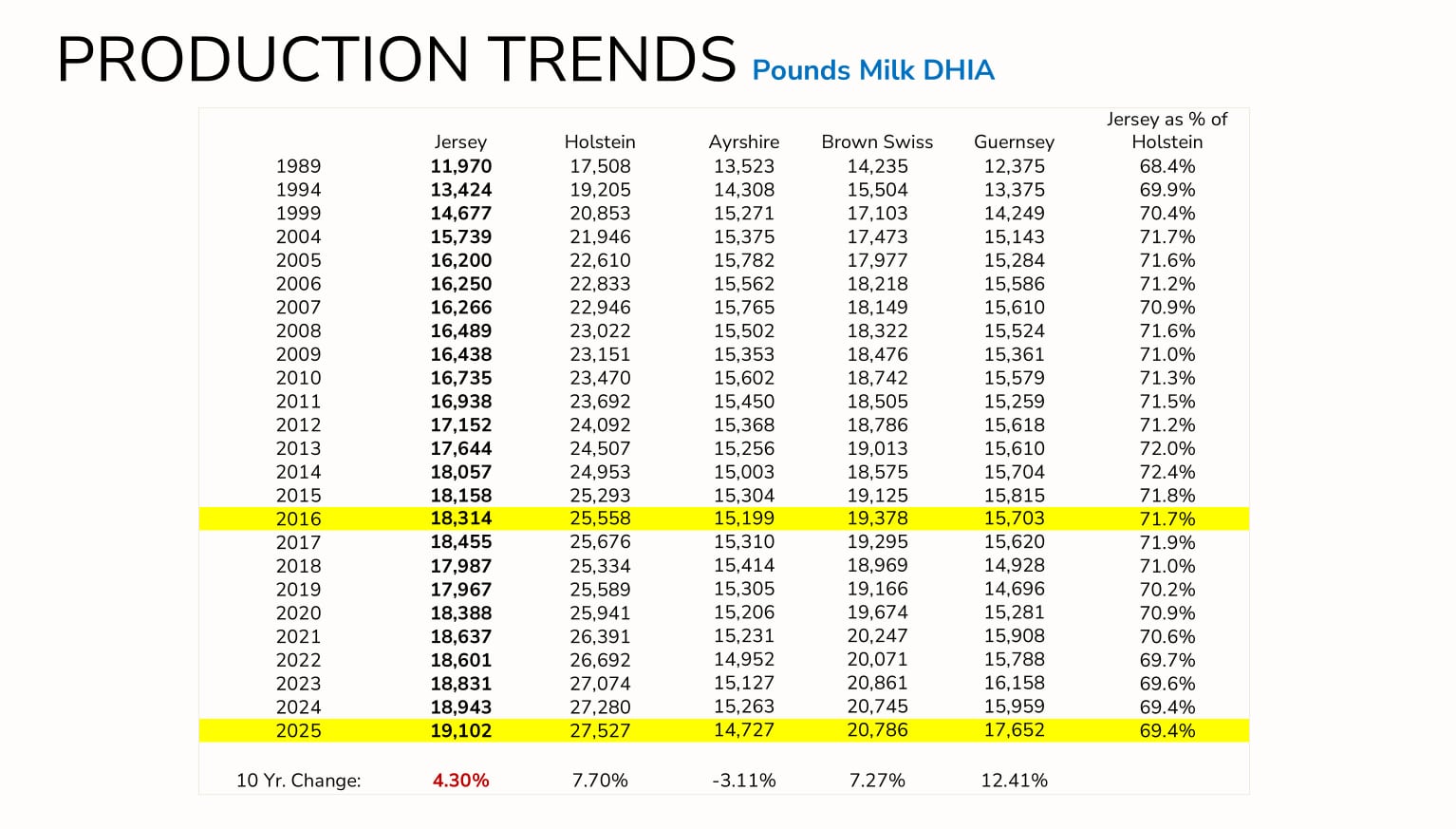
We have to improve faster.
I encourage every one of you to think about leadership. If you are not interested in serving as a director, think about someone in your district who is qualified and encourage them to serve. We need leaders who focus on what is best for the breed, not simply what is best for their own operation.
It has been an honor to serve this association. When Maury Core offered me this opportunity, I knew it was the opportunity of a lifetime. Looking back, I can honestly say it was exactly that.
Thank you for your help, support and cooperation. I’ve always believed we were people pulling together for a common purpose. This is a way of life. You are raising families at home from the milk check and hopefully earning income from genetic sales as well. It’s been a privilege to work alongside you, and I’ve sincerely enjoyed the journey.
I am confident the future is bright. Kristin Barlass Paul is prepared, educated and ready to lead this organization. I have no doubt she will do an outstanding job, and I ask you to give her the same support and cooperation you’ve given me.