Never Enough Cream: Red Ridge Finds a Niche
At a time when much of the dairy industry is talking about excess butterfat, one Jersey dairy in Oklahoma faces a different challenge.
“We never have enough cream,” said Steve Koehn. “We could sell a lot more cream—and I mean a lot more cream—if it were available.”
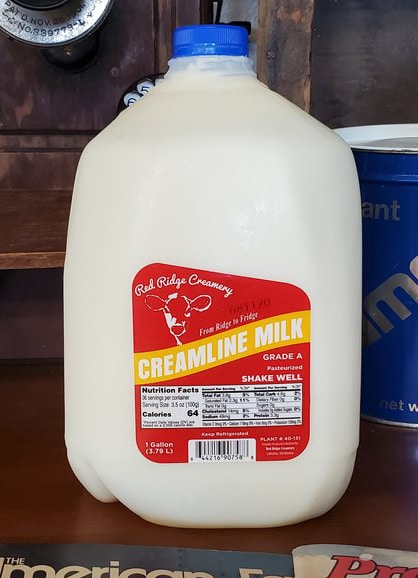
Steve and his wife, Patricia, operate Red Ridge Creamery, where they have processed milk from their Registered Jersey herd since 2019. In addition to cream, the family processes whole milk, cream-line milk and buttermilk.
The Koehns milk 80 Jersey cows near Meno in northwestern Oklahoma. Their connection to the farm goes back to 1914, when Steve’s great-grandparents bought the land. The first Jersey arrived at the place nine years later.
Research Steve conducted years ago with the late Bill Maness showed that about 80% of the current herd traces to that one animal, Foxy Star Lady, purchased as a 4-month-old calf.
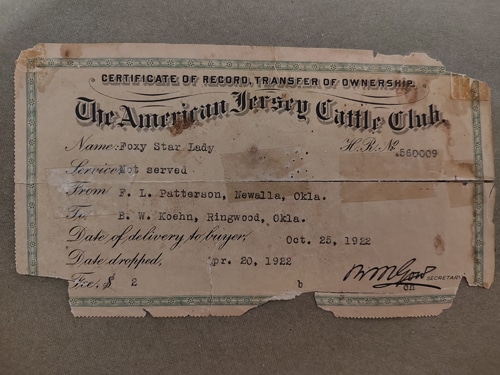
“My dad said he remembers hand milking ‘Lady’ as a kid,” Steve said. “So, she had to have lived forever. She had two very prolific daughters, too. We’ve not added an outside female to the herd since 1975.”
Today, Steve and their son, Blake, handle the farm with help from an employee who lives on the farm. Patricia manages the creamery with support from Steve’s nephew, Blair.
Cows are milked in a double-three herringbone parlor and graze when conditions allow. They are housed in a barn built by Steve’s grandfather and remodeled by his father in 1962. A 30-by-120-foot loafing shed provides additional housing.
During hot weather, cows remain on pasture until about 3 p.m., then move inside the barn to escape the heat and be milked before being turned out to pasture.
A Changing Landscape
Steve and Patricia married in 1995. Steve would have been content to milk cows and sell commodity milk indefinitely, but Patricia saw both opportunities and challenges with that scenario.
Their milk inspector, who has worked with the family since 1987, remembers about 1,600 dairies operating in Oklahoma four decades ago. Today, fewer than 50 remain.
“It’s hard to dairy here,” Steve said. “Oklahoma is a milk-deficit state. I have lots of friends who have left the dairy industry, not because they wanted to, but because they didn’t want to lose money.”
Patricia recognized the need to process milk long before Steve did.
“From day one, Patricia has said people would drink milk if it tastes like what we drink,” Steve recalled.
The Koehns were fortunate to work with a cooperative that gave them time to establish their processing business. Steve recalled the first conversation with his field representative, talking candidly about the plant that was to be built.
“I said, ‘How is this going to work?” Steve said. “He said, ‘Seems to me you’ve got a lot of processing to learn and a lot of markets to build up. Why don’t you use what you can, and we’ll pick up the rest?
“I couldn’t hang up the phone fast enough, and Patricia cried,” he continued.
The arrangement lasted about three years. As Red Ridge developed a customer base, the family used more of its own production. Eventually, Steve was calling the cooperative every other day to say there was no milk available for pickup.
At the same time, other local dairies left the business, making the hauling arrangement increasingly difficult to sustain. Finally, the cooperative told him, “I think we’re at the end of this partnership.”
“All I could do was say thank you,” Steve said.
Finding the Right Niche
The Koehns initially produced fluid milk, flavored milk, cheese and an ice cream mix. While cheese seemed like a logical fit for high-component Jersey milk, it proved to be a poor fit from a labor or marketing standpoint.
Cheesemaking was labor-intensive at their scale. The family made cheese on days when they were not bottling milk, but what was supposed to be an easier day quickly became another demanding job. After about three years, the growing market for fluid milk made the decision to streamline their product line easier.
“And honestly, that is where our heart is anyway,” Steve said.
Education became an important part of building the business. The family first “dipped their toes in the water” at a Value-Added 101 workshop presented by National All-Jersey Inc. in 2017. Later they attended a conference hosted by the American Cheese Society in Denver. Patricia completed processing and pasteurization training at the University of Wisconsin-River Falls and attended a farmstead cheesemaking conference in Pennsylvania with one of the couple’s daughters. Blake completed an internship with Kilgus Farmstead, a fellow milk bottler in Illinois, through the Fred Stout Experience.
Those experiences helped the family build a foundation, but operating the creamery reinforced another lesson: A processing model must fit the market it serves. What works in one region may not translate directly to another.
The Koehns caution that farmstead processing is not a simple alternative to selling commodity milk.
“It is not for the faint of heart,” Steve said.
The family entered the venture with a strong financial foundation, including no existing debt. That position made it possible to secure financing for the creamery. The first three or four years were difficult, Steve said, but the family continued building markets, adjusting products and refining the business.
Building the Creamery
The Koehns initially planned to build an on-farm processing plant, but when that was not feasible, they purchased a property nine miles away in Lahoma. The property included a 40-by-100 structure with a retail store and storage units, which they converted into a processing plant, along with a home where Blair now lives.
Blake hauls milk from the dairy to the plant in a 1,800-gallon, two-ton truck.
“The biggest advantage of having the creamery off-site is being on city water and sewer,” said Steve. “This was something we discovered after the fact. We also don’t have trouble with flies and don’t have to see it on the weekends, which doesn’t sound like much, but it is.”
Most of the processing equipment was bought used, with one major exception: a new high-temperature short-time pasteurizer, commonly called an HTST.
“People told us you don’t want to inherit someone else’s problems,” Steve said. “And with an HTST, that is the truth. They’re all unique, persnickety machines.”
Much of the remaining equipment came from a facility in Idaho. Patricia and several neighbors traveled there to disassemble the equipment, haul it back to Oklahoma, and then work with subcontractors to assemble the system at Red Ridge. It was not necessarily the route Steve would recommend, but it was the option available to them.
“If you have Jerseys, I think you almost have to have a separator,” Steve said. “It allows you to separate cream from skim and standardize different products to the butterfat levels you need.”
Red Ridge is somewhat unique among small creameries because its pasteurizer also includes a homogenizer. Homogenization breaks fat globules into smaller particles that remain suspended in the milk, creating the consistent texture many foodservice customers expect.
“The homogenizer is a big deal for us because a lot of our milk goes into food service, coffee shops, and upper-end restaurants,” Steve said. “I didn’t realize how complicated it is to explain milk to people.”
“‘So, it’s raw?’ they say,” Steve noted. “‘No, it’s not raw,’ I tell them. People simply don’t understand the difference between pasteurization and homogenization. They almost think they are the same. And the word ‘standardization’ can lead to an entirely new explanation.
“Really and truly, it is rocket science.”
Consumer education is therefore an important part of selling Red Ridge products.
A recent experience with a large coffee shop chain illustrates why that education matters. The buyer initially liked the idea of serving cream-line milk.
“The guy thought he wanted cream-line milk because it works great for hot coffee drinks,” Steve noted. “Patricia told him he might not like it as well in cold drinks, where the cream doesn’t melt.
The account was large enough that Red Ridge had already shipped several loads to get the customer started. Patricia’s advice proved correct.
“Sure enough, he called and said, ‘Okay, I should have probably listened. Can we just flip-flop and make everything whole with just a little bit of cream line?” Steve said.
Relationships Drive Growth
Steve’s experience marketing cattle prepared him in unexpected ways for marketing milk. The family supplemented its dairy income by selling cows, giving Steve years of experience working with buyers and building relationships. From that experience, he learned that successful sales often depend less on advertising than on trust, reputation and being ready to respond when opportunity arises.
“I never advertised that I had cows for sale,” Steve said. “I just didn’t have any enemies in the industry and was always honest with what I sold. It was essentially word of mouth.”
Red Ridge Creamery has grown much the same way.
“Our biggest customers have called us,” Steve said.
One opportunity began with a regular cattle customer who mentioned meeting a man at a cattlemen’s convention who was opening coffee shops in southwestern Oklahoma. The customer encouraged Steve to make contact. Three days later, Steve met with the prospective buyer, who wanted Red Ridge milk, but wanted it supplied through a distributor rather than delivered directly.
Steve met with the distributor, and by the end of the meeting, another opportunity had emerged.
“I don’t know if this guy is going to buy your milk through us or not,” the distributor told Steve, “but I’d sure like your milk on my truck.”
That became Red Ridge’s entry into distribution.
“You have to talk to people,” Steve said. “I didn’t go looking for him; in a roundabout way he found us.”
Another account came from a barista who had worked with Red Ridge milk at a previous job and recommended it to her new employer.
“Word of mouth can’t be beat, and you’ve got to guard that like gold,” Steve said.
Customers are buying more than milk, however. The personal connection is often an important part of what Red Ridge offers.
“A lot of people who buy our milk want that fuzzy connection with the farmer and to know about our milk and our family and how all this started,” Patricia said.
Selling Every Drop
Today the creamery is fortunate to be selling all its milk. But that has not always been the case.
“We have been bringing all our milk to the creamery for quite a while and then separating it and blending it to create what we need as milk and cream,” Steve said. “But we have always had a certain amount of skim that had to be dumped. For the past two months, we have used every bit of it. But we are very aware that all we have to do is lose an account or two and we’re back down.”
That success also creates challenges when it comes to finding new customers.
“It is very hard to make sales calls when you don’t have anything you can deliver to them tomorrow,” Steve said.
The family has also learned that customers can disappear as quickly as they arrive. The coffee shop owner who helped introduce Red Ridge to its distributor expanded too quickly and eventually went out of business. He continued to order milk until the day the business closed.
For commodity processors, six or seven coffee shops using 50 gallons of milk a week might be insignificant. For Red Ridge, it is substantial.
A Family Tradition
The Koehns chose the Red Ridge name from a photograph of heifers standing on a ridge of red dirt on the farm, a fitting reference to Oklahoma’s red soil.
Patricia sees a similar affinity for cattle in the next generation.
“I had people in the Koehn family tell me cow sense is in their blood,” she said. “I thought, ‘Yeah, right.’ But after I married Steve and saw the way Blake takes to cows, it is very much the same. I think it really is part of their DNA.”
For the Koehns, that connection now stretches from a Jersey cow brought to the farm in 1923 to a modern creamery serving customers who value Jersey milk and knowing where it comes from.
And while much of the dairy industry is looking for ways to manage excess butterfat, Red Ridge Creamery has built its niche around the opposite problem: There is never enough cream.
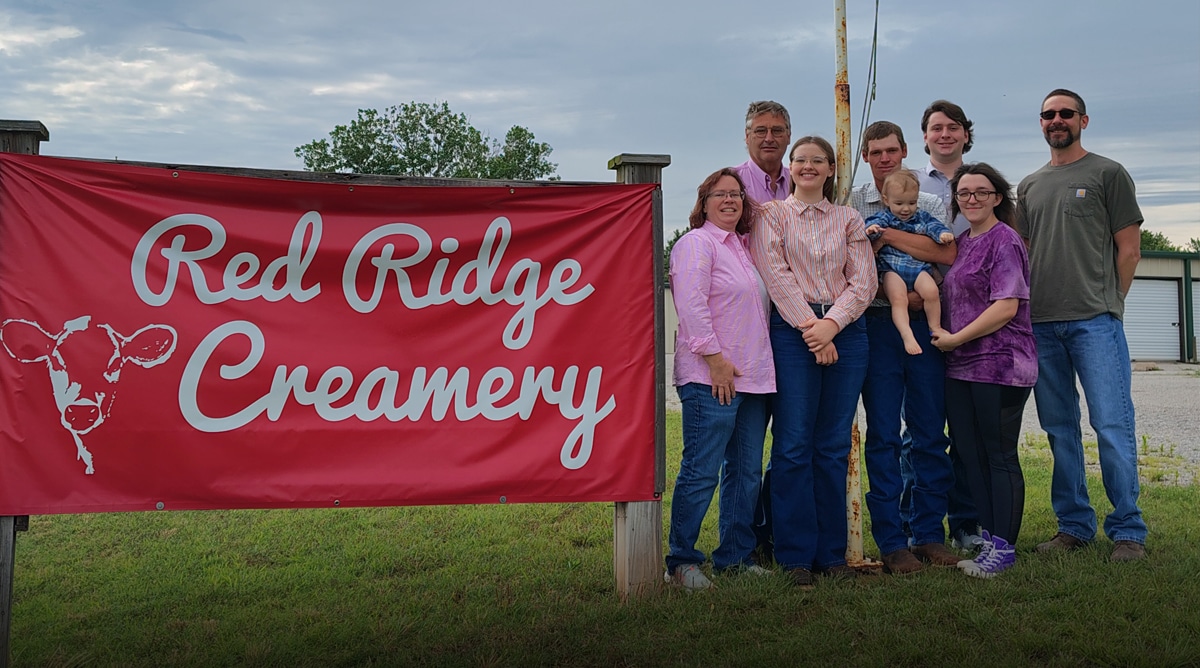
Feature Photo: Patricia and Steven Koehn, left, operate Red Ridge Creamery and an 80-cow Registered Jersey herd with their daughter, Chloe, third left; son and daughter-in-law, Blake (holding his son, Lane) and Ashli, center; son, Jackson, second right; and Steven’s nephew, Blair Clinesmith.