
Back to Basics of Jersey Young Sire Usage
Progeny testing has been and will continue to be the primary driver of dairy cow genetic improvement.
Progeny testing is an animal breeding method where a bull’s genetic value is evaluated based on the average performance of his daughters. This process involves mating the bull to a reasonable number of females, raising the female progeny, and then measuring how the daughters perform for specific traits, such as milk yield, somatic cell score, calving interval, longevity, and confirmation through the calculation of Predicted Transmitting Abilities (PTA). By analyzing the collective results, breeders can identify which bulls have daughters that are superior performers, allowing them to select the best sires for future breeding.
Genomic evaluations for unproven bulls were first introduced in 2009. This technology adjusted a young bull’s Parent Average (PA), the average of its parent’s PTAs, based on the regions of DNA that the bull had inherited from his parents. Prior to this time, only PAs were available for young bulls. In 2012, the board of directors of the American Jersey Cattle Association recommended that breeders make at least 80% of all matings to genotyped young bulls enrolled in progeny test programs to maximize the genetic potential of their herds. It has been long enough that we can now look back and determine the effectiveness of genomic PTAs in identifying those bulls that sire the best performing daughters.
The genomic PTAs (GPTA) and PAs of 616 Jersey bulls, at the time they were 12 to 18 months old, were converted to the 2025 genetic base and then compared to the actual daughter differences of those bulls on their April 2025 genetic evaluations.
The bulls included were born from 2010 to 2019 and had a minimum Reliability of 90% on their April 2025 genetic evaluations. The traits evaluated were Milk, Fat, Protein, Productive Life (PL), Somatic Cell Score (SCC), and Daughter Pregnancy Rate (DPR). Jersey Performance Index (JPI) and Cheese Merit Dollar (CM$) values for each bull were approximated using the current weightings of these six traits in those indexes. Chart 1, below, compares the relationship (correlation) between the Parent Average or Genomic PTA of the bulls at the time they were 12 to 18 months old to their Daughter Differences in April 2025. The relationship to daughter performance for genomic PTAs is higher than for Parent Averages but likely not enough higher to justify the heavy use of any individual young sire.
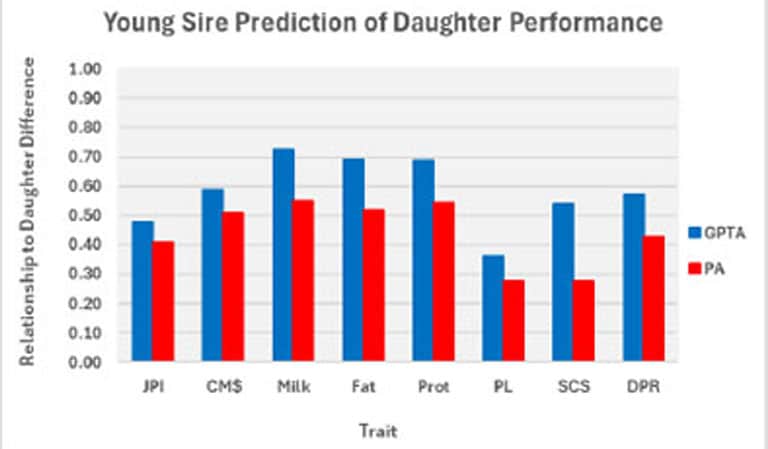
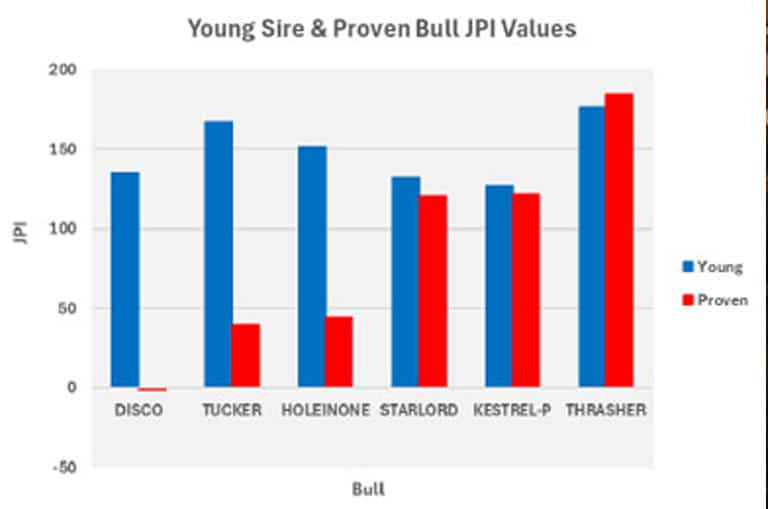
Chart 2 compares the young sire genomic JPI, calculated only from PTA Protein, Fat, PL, SCS, and DPR, and the current daughter proven JPI of six high profile Jersey bulls to show genomic PTAs are not an effective method to accurately rank individual young sires. The height of the blue bar is each bull’s young sire genomic PTA (at 12 to 18 months of age) for JPI, and the height of the red bar is each bull’s daughter proven JPI in April 2025.
All six bulls were similar as young sires for genomic JPI but ended up being quite different based on their daughters’ performance. Most concerning from a genetic improvement perspective is that the three higher current JPI bulls (Primus Craze Starlord-ET, Primus Comanche Kestrel-P-ET, and JX CDF JLS Pilgrim Thrasher {6}-ET) have half as many total milking daughters (12,175) as the three lower JPI bulls (Oaklane Dazzler Disco 2127-ET, Victory S-S-I Miami Holeinone-ET, and Rowleys 1996 Daniel Tucker {6}-ET) who have 24,759 total milking daughters.
Another historical review was done using PTAs from August 2011 through December 2020 to compare the past and current PTAs of the top 10 genomic young sires to the top 10 proven bulls at the time of selection. JPI and CM$ were estimated using only the current weightings for PTA Milk, Protein, Fat, PL, SCS, and DPR.
The next two charts show two different comparisons. Chart 3 compares the average JPI of the top 10 JPI young sires and the top 10 proven bulls at the time of selection. At the time of selection, the top 10 young sires averaged 30 points higher for JPI than the top 10 proven bulls.
The chart below it compares the current average JPI of those same 10 young sires and 10 proven bulls now that both groups have milking daughters. The same young sires, now proven, average only one point higher for JPI than the same proven bulls.
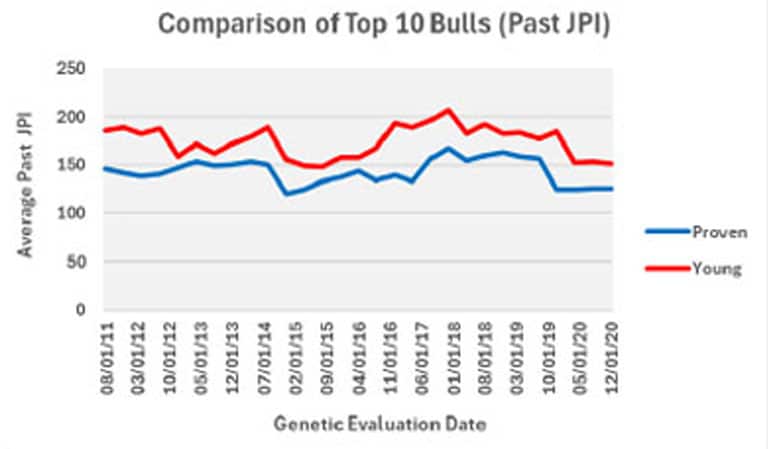
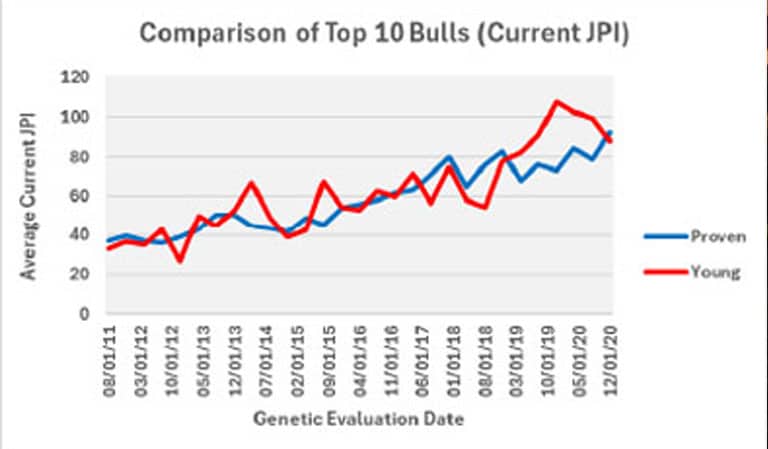
Because the genomic PTAs of young sires are overestimated, the genomic PTAs of young sires should not be compared to the PTAs of proven bulls when deciding which bulls to use in your herd. The changes in the PTAs of the top 10 young sires relative to the top 10 proven bulls for each PTA are listed in the table below.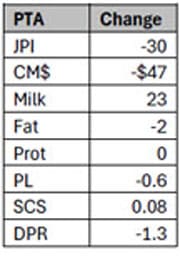
Although genomic testing is a useful tool for ranking an unselected group of Jersey heifers, it doesn’t accurately determine the genetic differences among a group of highly selected Jersey young sires. Only progeny testing, measuring the differences between the daughter performance of those bulls, can do that.
Based on the information shared in this article, in November 2025, the American Jersey Cattle Association board of directors made a change in recommendation that Jersey breeders should make 50% of the dairy matings in their herd to proven bulls and 50% to young sires. Individual young sires should be used lightly with no more than 2% of the dairy matings in a herd to an individual young sire. Those proven bulls found to sire the most productive daughters should be used heavily.


